Before I left Manila (and school) for good, home was a walk-up on Vito Cruz Street.¹ It was my last address after numerous moves from such diverse points as Makati, Quezon City, Las Piñas, and my friend Bubbles’ place in Parañaque. I was constantly relocating that Ma had stopped keeping track; she made up for that by refusing to send my allowance unless I cabled first.
Vito Cruz, if you don’t know, intersects with Taft Avenue where the cities of Manila and Pasay meet. Coming from our place, you turned right at the LRT line and there’s La Salle up ahead. That was where I was supposed to get my education. And I did… after a fashion. Let’s just say most of it wasn’t the kind my mother had in mind.
But I am not here to incriminate myself, so let’s go back to that old apartment. It was one of two units on the top floor of a three-story building. Access was through an iron gate next to a karaoke bar on the ground floor. I had to shout from the sidewalk to whoever happened to be on the upper floors, hoping that my cries were heard above the din of traffic as it whizzed past. “Carlooo! Looo! Ano baaa, buksan mo na gaaate!”
Carlo was my flatmate and fellow Bisaya. He hailed from Cebu; I was from Leyte. We shared the apartment with two schoolmates, Marlon and Joel. Marlon was from Batangas. He he was broad, big-boned, and all sharp angles. He looked tough, acted tough, and that was all there was to it. Joel was Ilocano, from La Union. He was swarthy and portly, with a perpetual five o’clock shadow. We called him Bomber for his uncanny resemblance to the character actor Bomber Moran.² He was our baby, Boom-boom was, and we treated him the way big brothers were supposed to, i.e., we bossed him around (“Boom, hugas ka na ng pinggan!” “Boom, bili ka nga ng yosi sa baba!”).
Carlo? He was… well, he was tubby. Or at least chubby. He had slits for eyes and a hyena’s laugh. A cocky bastard, too, which was fine by us; he took to running the household as a matter of course. It did not hurt that he was an early riser, did the marketing, and scrubbed the floors without having to be asked. Plus he could be counted on to get things done. Me: “Lo, tamad na naman maghugas si Bomber.” Him: “Boom…” Bomber: “Ukinam naman, o. Maghuhugas na po!”
I was the odd man out, if not the most senior. And queer. They knew what they were getting. We used to live in the same boarding-house. Of our ex-boardmates, two were due to graduate, two were addicted to gambling and up to their necks in debt, and the other two, brothers, had so exasperated our landlord with their drug habit he had had the police raid the place (after warning the rest of us, of course). This was shortly before he decided to close his doors to boarders for good.
That, by default, left yours truly. At that point most of my barkada had graduated and I was running out of places to crash. Besides, I did not look forward to making acquaintances of strangers in some back-alley dorm. Better the devils I knew.
To be honest, I could not have asked for a better group of people to share space with. Our old boarding-house was a residence, with live-in landlords, their kid, and the landlady’s two sisters (good people all, I should add). The house itself was old but well-kept, with hardwood floors, big rooms, and high ceilings. Very comfortable. Homey, even.
The apartment? Open the front door and there was the kitchen sink. Beyond that, the bathroom. A tiled counter on the left held a single-burner stove. No refrigerator; we had a Coleman jug instead. To the right was the kitchen table, which also doubled as our work/study area, often at the same time.
A narrow hallway bisected the kitchen and bedroom, culminating at the farthest end in a stairwell (all of two steps, really) that led to a storage space — or attic, if you will. We all bunked there, because even though it was closest to the roof (there was no ceiling) and we couldn’t make our way around it without stooping, at least we were shielded from the direct glare of the sun. No such luck in the single bedroom (we couldn’t afford curtains). Besides, there was only one electric fan, so it made sense to stick together. It was the closest I came to living in a kiln.
Then there was the matter of sustenance. We were used to being served three square meals a day. By a Kapampangan cook, no less.³ We might have groused about Ate Helen’s cooking on occasion, but at least we always had something to look forward to come mealtime. We never thought that a luxury until we moved out and had to fend for ourselves. After several days of liempo, lechon manok, and Red Horse Beer, we had to acknowledge the void in our pockets and sit down to do the math.
Rent. Electricity. Water. We agreed to split those expenses equally. Food? We dealt with it on a meal-to-meal basis, which was to say it was pretty much a hand-to-mouth affair. If we had just received our stipends, we splurged at KFC, Wendy’s, or the Japanese restaurant at the nearby mall. If Carlo’s mother was in town (work often took her to Manila), we had dried danggit to see us through for a few days. Marlon went home weekends and always brought back lambanog — dirt-cheap coconut vodka that peeled the lining off your guts and guaranteed a deep, dreamless sleep. That was food, too.
Mostly we subsisted on Lucky Me instant pancit Canton. I would prefer to say that we made do with it, but the fact was that it was a novelty back then. Did you know it was introduced in 1991? It is so ubiquitous nowadays it is easy to assume it has been around forever, like balut, Chiz Curls, or Manong Johnny Enrile. But in those days it was big news indeed.
And why not? It was a godsend, requiring only that you knew how to boil water and count to three minutes. Who cared if it was nothing like the pancit Canton we ate back home? What could be, at a mere three pesos a pouch? We were practical when times demanded it. On days when we could only scrounge up a few pesos amongst ourselves, no problem — that was more than enough for Lucky Me, rice, Coke, and the postprandial Tanduay rum.⁴ (We always factored alcohol into the budget. That’s the thing about living with other people — you have to agree on priorities.)
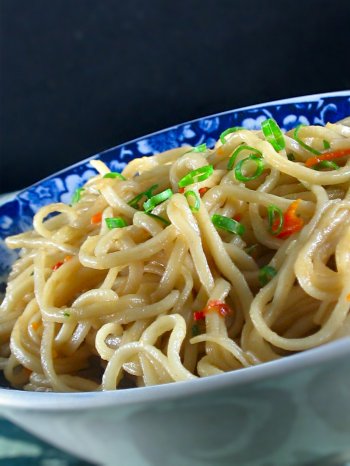
That said, I don’t blame you for thinking that I’m building Lucky Me up for a fall. If anything, it’s more dumbed-down than Titang and Terê’s pancit from my grade school days, garnished as that was with bits of mystery meat and vegetable shavings in a desultory bid at legitimacy. Well, Lucky Me doesn’t even try. It doesn’t appear to, at least. Open a pack and there’s dehydrated noodles, a sachet of flavored powder, and another sachet of soy sauce and oil. And yet it tastes like nothing else in this world — real pancit Canton included, odd as that may sound. Let’s just say that Lucky Me (don’t even mention it in the same breath as Quick Chow or Payless) and authentic pancit Canton bring their own unique pleasures to the palate, and I would never opt for (much less mistake) one over the other.
In case you’ve ever wondered about Lucky Me’s “special seasoning,” Jaden Hair of Steamy Kitchen has a recipe which comes pretty close. Heat three tablespoons of margarine (I use garlic-flavored Star, but salted butter is better). Throw in three cloves of minced garlic and a handful of chopped spring onion, wait until the garlic has browned a bit, then add four tablespoons of oyster sauce, two tablespoons of light soy sauce (Knorr or Maggi seasoning if you have it), two tablespoons of sugar, and some dried pepper flakes if you prefer some heat. Stir well. The sauce should be good for 250 grams of precooked Canton. Finish off with kalamansi juice.
If you have read this far and paid attention, you may have noticed the carrots — that is, they are in the photo but not in the recipe. I confess that I belatedly added some to the dish to make for a more colorful photo. Of course you could add carrots — or whatever meat, veggie, or fungus you fancy. But I don’t recommend it. There is something about the distinctive taste of Lucky Me (or, in this case, an imitation of it)⁵ that doesn’t lend itself to such over-elaboration. Anything extra only gets in the way between your taste buds and the unctuous, salty-sweet noodles. Why fix it if it ain’t broke?
I have one more confession to make. I had help. Remembering, that is. Did you think I dredged up those details by myself? I can not even recall what I had for lunch yesterday, much less what happened two decades ago.
Therese has no trouble in that department. “Remember the time the laundrywoman’s house burned down?”
“We, um, lost our clothes?”
“That was crazy, wasn’t it?”
I’m sure it was. See, Wewe came to live with us a few months before I left. She had been looking to rent her own place but we prevailed upon her to stay. We had room to spare, after all. And she was best friends with Carlo’s older sister.
Besides, it was truly difficult not to like her. Or be immune to her enthusiasm. Nothing was ever so-so with Wewe; it was either “million-million!” or “makabuang!” (maddening). Even as she pinned her born-again heart on her sleeve, peppering sentences with “Praise Jesus!” and “Hallelujah!,” she never gave us sermons or sass. She made us pray before meals, though. And massaged us out of more than a few hangovers. And generally cleaned up after us. “What a mess! Million-million! Lord help me put this pigsty in order!” Then she would roar in laughter and get down to work. She was that kind of person.
She still is. A little thicker around the waist these days, for sure, but I am no spring chicken myself. Twenty years! Had it really been that long since we last saw each other? That gave us plenty to talk about. Or rather, her. She’s a sponge, I’m a sieve — what else was new? She talked and I listened, amazed at the things I had managed to forget. Oh? Did I? You don’t say! We were so into it we forgot our order of pork something-or-other hadn’t arrived, perfectly content as we were with the memories and the chop suey.
Pancit Canton? It was on the menu. We never even thought about it.
¹ Now Pablo Ocampo, Sr. As it turns out, Vito isn’t Mr. Cruz’s first name — it’s Hermogenes. Vito Cruz is, in fact, a double-barrelled surname. «
² Real name: Arturo Moran (1944-2004). Per this obituary, he appeared in over 400 movies. He was almost always cast as a bad guy (in action films) or a clueless bad guy (in comedies). (Of interest: a tribute from a “bear” lover.) «
³ The province of Pampanga prides itself as the country’s culinary capital. The landlords were also Kapampangan, from Guagua, birthplace of Razon’s halo-halo. «
⁴ Let’s get our liquors straight. Red Horse Beer was our drink of choice. It was cheaper and stronger than San Miguel, and if you’ve ever tried it, you should have an idea why people call it traidor. Tanduay, the local rum, was much cheaper. And way more potent. Tequila? See you when I receive my allowance. «
⁵ Actually, this recipe is an imitation of an imitation. Lucky Me has come a long way indeed. «


This post has no comments.
Post a Comment